Silver Sky human experimentation
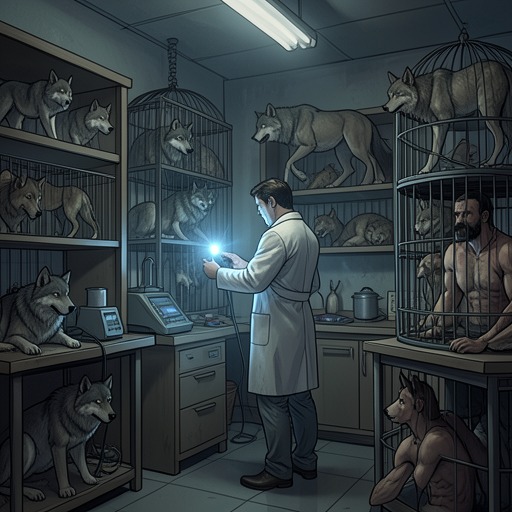
The Werewolf Mates Anthology (Erotic Romance)Silver Sky human experimentation is the hidden practice beneath the institution’s public-facing wolf research: employees are selected as subjects, held in concealed cells, and subjected to procedures whose purpose remains unknown. The contrast between an ordinary research workplace and a secretive system of bodily control makes the program more than a concealed crime. It puts scientific authority, electronic records, security infrastructure, and vulnerable people into one chain of power—and gives the people trying to expose it a trail of absences, altered access, and compromised evidence.
Public Research and Hidden Purpose
Silver Sky Research presents itself to Kelly Shaw as a place for legitimate wildlife science. At twenty-nine, newly finished with her PhD at the University of Oregon, she has been selected for post-doctoral work on an animal research project outside Boise. Its stated focus is wolf migration and whether expanding wolf reintroduction would benefit modern life. Kelly’s professional hopes are therefore bound to the institution before she has reason to suspect that its work extends beyond animals.
That respectable account becomes harder to trust when Kelly recalls an incident from the day of a later break-in. On the 28th, Silver Sky’s servers crashed; she also remembers that a file share became password-protected soon afterward. She discovered the change accidentally by opening the wrong folder, whereupon an IT employee came to check on her and the folder then disappeared from her computer. The official investigation had treated the server failure as unrelated to the break-in, and the accused had claimed no knowledge of it. Kelly’s account does not establish exactly what the missing folder contained or who changed its access, but it adds a concrete, internal clue to suspicions surrounding the facility.
The gap between the institution’s public identity and its concealed operations is also built into its physical environment. Jacob Pitman finds the offices unremarkable: beige walls, fluorescent lights, paintings of wolves and other wild animals, windows in office doors, and name tags. Nothing in this surface arrangement suggests that people are being held there. Beyond fire doors, however, he reaches a lab with white walls and workstations, then discovers a hidden, pressure-activated door disguised as part of the wall. It opens onto a dim staircase leading down toward the holding areas. The route makes concealment part of the facility’s design: the ordinary offices do not merely fail to reveal the cells; they help keep them out of view.
Selection, Confinement, and Bodily Effects
Jaz Pitman’s disappearance gives Jacob a personal reason to investigate. She had begun working at a Silver Sky Research facility in Montana four months earlier and vanished after a month. The company stonewalls Jacob, while the police find nothing. He makes progress only after Rodney Gilcrist, Jaz’s ex, tells him that the company is experimenting on its own employees in Idaho. Jacob discovers that Jaz is at the facility he plans to enter, although the evidence presented here does not establish what procedures she has undergone or whether she is ultimately released.
Abigail McKinney’s confinement provides a more detailed view of the program’s treatment of a subject. Her last remembered moment of freedom is in her office, where her supervisor, Damien Greggs, arrives to discuss her latest report. Abigail has felt sick all morning; before the conversation can continue for more than a few minutes, she collapses. She wakes in a cell and remains there for three days, ill and in a coma-like state. The room affords almost no privacy: the bed, toilet, and tiny sink are all visible to her captors, and she can do little more than splash water on herself.
Her captivity is controlled beyond the walls of the cell. Abigail hears another girl in a different cage, but the captors prevent them from speaking. Two armed men dressed in black later drag Abigail out, though she never sees the other girl’s face. In a separate incident, she is taken in a car and experiences an intense, disorienting sexual compulsion. Jacob suspects that whoever held her has drugged her; his suspicion is not confirmed, but he recognizes that her condition is not an ordinary, self-directed response. He restrains her hand and continues driving rather than act on his own arousal. The episode presents her body as something affected and acted upon while she lacks a clear understanding of what has been done to her.
Silver Sky’s connection to Abigail’s transformation is strongly suggested but not fully explained. Kelly tells her that Silver Sky has conducted unauthorized, unvetted human testing and that Abigail appears to have been chosen as a subject. Abigail associates her illness with the time Greggs came to Boise. She has also awakened from the coma-like state with a new wildness, and Kelly identifies her experience as resembling what happened to her and Max after they became werewolves. Abigail rejects the explanation, so the revelation does not resolve her fear or supply the experiment’s mechanism. It establishes the stakes: the institution’s hidden testing coincides with a profound change in the people it holds.
Security, Concealment, and Resistance
Jacob’s first infiltration is calculated around the facility’s routines. At 12:37, he expects guards to change positions, giving him three minutes to enter, disable the camera feed, substitute looped video at an unmanned guard station, interfere with holding-cell sensors, unlock doors along his route, and set off a false alarm elsewhere. He uses a stolen ID card and obscures his face with a hood. The plan treats cameras, alarms, sensors, doors, and guard schedules as parts of a single security network—and as points that can be exploited. He succeeds in getting inside, but his intended rescue of Jaz leads him into the hidden spaces where he finds Abigail.
The consequences of that breach are immediate. By the following day, Jacob believes the security weaknesses will be repaired and returns to observe the site rather than attempt another daytime entry. Black SUVs pass him on the road, and from a concealed position more than a mile away he sees that the guards have doubled. The company’s response shows that its secrecy depends not only on hidden rooms but on active surveillance and rapid adjustment once an intrusion is suspected.
The program’s effort to suppress scrutiny also reaches beyond the facility. After Abigail’s rescue, Kelly reports that Damien Greggs has told colleagues Abigail went on vacation, a story that would discourage them from looking for her. Kelly doubts it because Abigail had not mentioned any planned trip. Max then states that Silver Sky is doing more than studying wolf migration and that the group had been watching Greggs, intending to move against him. The cover story and the surveillance of Greggs indicate that the hidden program has consequences inside the workplace as well as in its cells, though the precise chain of authority behind each act is not disclosed.
Exposure and Unresolved Consequences
The program becomes visible through several kinds of testimony and evidence rather than a single complete disclosure. Kelly’s recollections supply details about the server crash and vanished file share. Abigail’s experience links a workplace collapse, prolonged confinement, and unexplained bodily changes. Jacob’s search uncovers the concealed cells and brings him into conflict with the institution’s security. When Kelly and Max meet Abigail after her rescue, they tell her directly that Silver Sky has been conducting unauthorized human tests and that she appears to have been among its subjects. Her response is disbelief, not acceptance, underscoring how little control she has over either the experiment or the explanation offered for it.
Jacob’s later capture exposes another coercive method without settling the fate of Jaz. He is offered a bargain: Jaz will be released in her current condition, supplied with clothes, and left in the city, while he is threatened with death if she goes to the police. Jacob accepts because, as he sees it, her release matters more than what happens to him. He extends his hands through the bars, and a doctor’s assistant cuffs him and injects a slightly sinister green liquid into a vein; it burns. The scene makes the experiment’s power brutally direct: Silver Sky can use the person Jacob is trying to save to compel his cooperation, then physically intervene in his body. The promised release is not independently confirmed in these events.
Even after waking, Jacob remains confined and managed through routine. He is given only red meat, notices the attendant has left a keycard within reach, and uses it to unlock his cage. The attempt lasts only two steps into the hall: an alarm sounds, red lights flare, and a guard arrives with a gun. His failed escape leaves him captive and still without a secure way to help Jaz. Across these episodes, Silver Sky’s human experimentation is defined as much by the machinery that hides and contains it as by the procedures themselves. Research credentials and office routines obscure the program; records and workplace explanations can be altered or withheld; cells, alarms, and guards enforce confinement. Yet the same infrastructure produces openings—an anomalous server crash, a forgotten card, an unlocked route—and those small failures keep the institution’s supposed secrecy from becoming complete.